What can humanoid robots actually do in 2026?
Humanoid robots can move containers between machines, place components in fixtures, prepare assembly kits, sort parts, learn manipulation skills in laboratories and perform programmed shows. Some of these activities already happen at customer sites. Others are still trials or proposed applications. The human-shaped body is useful when a job requires reaching into existing workstations, moving between them and working with the same objects people handle.
This guide starts with the physical task rather than the robot brand. It distinguishes documented work from demonstrations and proposed uses, then explains the hardware, workflow and acceptance test for each application. The final sections contain the dated commercial evidence and a worked cost-per-task comparison.
| Application | Example robot and setting | Evidence | First performance measure |
|---|---|---|---|
| Warehouse tote transfer | Digit at GXO | Commercial operation | Successful totes per scheduled hour |
| Automotive fixture loading | Figure 02 at BMW | Completed pilot | Correctly seated parts per hour |
| Parts sequencing | Figure 03 at BMW; Atlas at Hyundai | Announced new project / training | Correct slots per completed kit |
| Kitting and lineside delivery | Apollo at Mercedes-Benz and Jabil | Pilot program | Complete kits and missed deadlines |
| Visual sorting and inspection | Apollo at Jabil | Pilot scope | Missed defects and false rejects |
| Machine tending | Atlas product application | Proposed application | Safe completed machine cycles |
| Domestic chores | 1X NEO | Product offering / assistance model | Tasks completed without remote help |
| Care support and dangerous-site inspection | Illustrative future workflows | No routine deployment established here | Safety, recovery and assistance rate |
| Research and education | Unitree G1 and H1 | Research platforms | Repeatable trials and recorded data |
| Entertainment and rental | Humanoid games and event hire | Documented activity | Completed routines or competition results |
1. Warehouse logistics: transfer a tote from a mobile robot to a conveyor
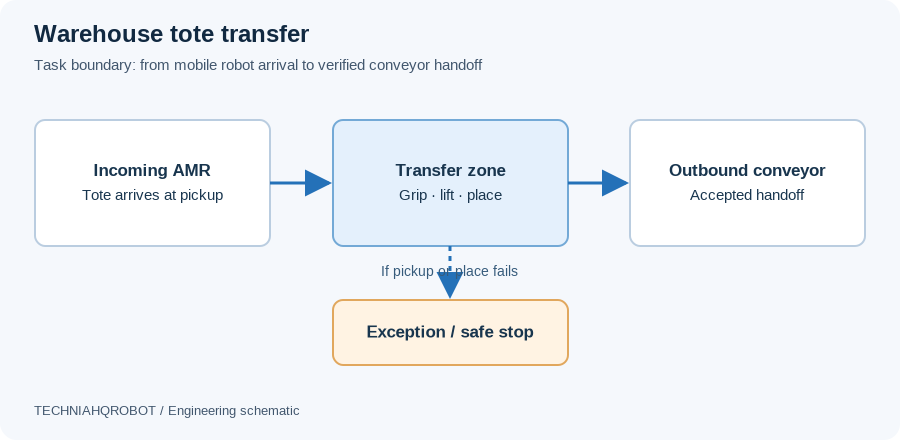
Digit is a bipedal robot with two arms. At GXO in Georgia it handles totes in a workflow already served by autonomous mobile robots and conveyors. Agility reports more than 100,000 totes moved cumulatively. The October 2026 expansion announcement adds planned sites in North Carolina and Tennessee for early 2027; those sites are not counted as operating deployments here. [3] [Source ↗] [Source ↗]
How the task works
- A mobile robot arrives with a tote. The transfer zone must be clear before picking begins.
- Perception estimates the position and orientation of the container. The robot approaches within its reach envelope.
- Both hands or a suitable end effector establish a secure hold; the controller coordinates the lift, body balance and transfer.
- The robot places the tote onto the conveyor; a downstream confirmation signal can verify the handoff.
- A blocked conveyor, misaligned tote or failed grip should trigger a safe stop or exception workflow instead of an unverified retry.
Required engineering interfaces include container dimensions and mass, pickup height, conveyor availability, fleet dispatch and a way to report failures. The actual sensor suite and software interfaces should be obtained from the vendor; the above is a functional design.
A useful trial mixes empty and loaded totes, changes pickup alignment within approved tolerances and includes a temporarily blocked conveyor. Record accepted transfers, damaged containers, stoppages, interventions and effective rate over the whole shift. A fixed arm is worth comparing when both pickup and drop-off positions never move; a humanoid is more relevant when one robot must serve multiple existing stations.
2–4. Manufacturing: fixture loading, sequencing and kitting
Fixture loading and sheet metal: Figure 02 at BMW
BMW reports that Figure 02 placed sheet-metal components for welding at Spartanburg and contributed to production of over 30,000 X3 vehicles in ten months. That figure describes cars supported by the project, not the number of robots or parts placed. The robot performed the material-positioning step rather than assembling an entire car. [1]
For a fixture-loading cell, the project must define part variants, allowable placement error, gripping surfaces and the signal that permits the next machine cycle. Vision locates the part, the manipulator controls its orientation and an independent check confirms seating. A part that is reversed or only partly seated is a fault even if the grasp was successful. Compare the robot with a dedicated industrial arm when the station is stable and the same cycle repeats.
Part sequencing: Figure 03 and Atlas
BMW describes a new Figure 03 workflow in which components arriving in mixed containers are sorted into a trolley for onward delivery to the line. Boston Dynamics opened the Hyundai training center in September 2026 to train Atlas in component logistics and sequencing. These are separate projects and neither supplies a verified hourly production rate in the cited records. [1] [Source ↗]
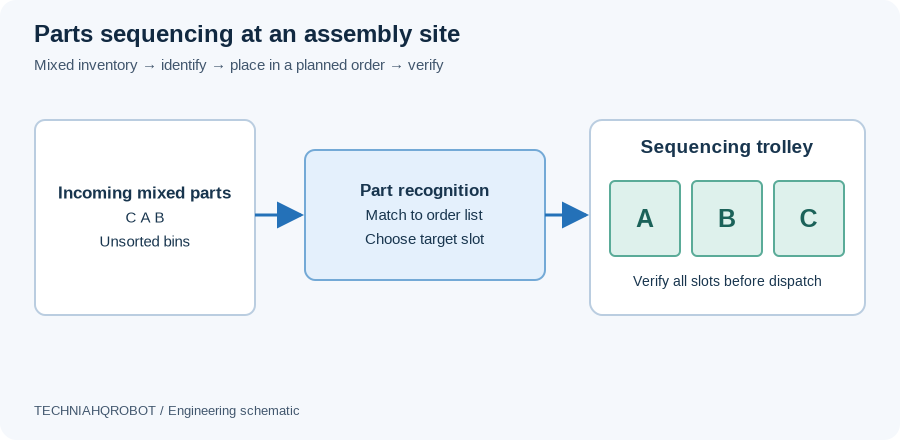
A sequencing system needs an order manifest, part identity or visual classification, a location map and confirmation of each occupied slot. It must reject a missing or wrong component instead of dispatching a trolley that will interrupt the assembly line. Record correct sequences, partial kits and recovery time after a missing component.
Kitting and lineside delivery: Apollo
The Mercedes-Benz and Apptronik agreement explores kit preparation, inspection and movement of parts to assembly. Apptronik and Jabil also announced a factory pilot with repetitive manufacturing and intralogistics activities. These application descriptions identify candidate jobs, rather than publishing achieved production throughput. [Source ↗] [Source ↗]
Kitting differs from sequencing: the immediate goal is a complete set of components in the correct compartments, even when pickup order varies. A robot must identify each item, count it, place it without damaging it and report a shortage before delivery. For lineside transport, compare a wheeled cart or autonomous mobile robot; legs offer little benefit on a clear flat corridor if the job is transportation alone.
5–6. Inspection and machine tending
Visual inspection and sorting
In the Jabil pilot scope, inspection and sorting are among the stated candidate tasks. A typical inspection station requires consistent lighting, a camera view of the surfaces to be checked, known examples of defects and separate destinations for accepted and rejected parts. A robot rotates the component only if inspection of multiple faces is required. [Source ↗]
Test with known good and known defective parts, including defects obscured by glare. Report false accepts (bad parts passed), false rejects (good parts discarded) and cycle time. If a fixed camera sees all required surfaces and the parts arrive on a conveyor, a camera and diverter may be cheaper and easier to validate than a humanoid.
Machine tending
A machine-tending application transfers material into or out of an existing machine. Atlas is being prepared for industrial workflows including machine tending; this example explains the requirements, not a documented production deployment. [Source ↗]
- Determine the machine loading position, safe access state, part weight and permissible grasp.
- Only enter the machine workspace after its interlocked interface grants access.
- Place the part into the fixture without contacting prohibited surfaces; verify acceptance.
- Leave the safeguarded area before permission to start the machine cycle.
- On a fault, hold or stop in an agreed safe state and follow the site recovery procedure.
7–8. Home assistance, care support and dangerous-site work
Household tasks
1X describes NEO as a home robot with a service through which an owner can arrange remote guidance for unfamiliar chores. This is important because a task can be completed with teleoperation even when the robot has not learned to do it independently. The original market survey below records the announced consumer plans and evidence limits. [Source ↗] [Source ↗]
Consider putting away a plastic cup: a practical workflow identifies a safe grasp region, checks whether the cup is empty, carries it to an accessible shelf and releases it once supported. Your trial should vary cup position and orientation, check whether the robot knows when to ask for help and prevent operation near children, pets, stairs or fragile objects until the manufacturer explicitly supports those conditions.
Care support and hazardous environments
An illustrative low-risk assistance job is delivering a sealed, non-medical item to a staffed collection point. A hospital delivery robot on wheels may be better suited to long flat corridors. Handling medicines, lifting people and medical procedures require separate clinical, safety and regulatory validation; household automation claims provide no evidence for those jobs.
For a dangerous-site inspection concept, a robot could carry a camera to a designated observation point and transmit imagery without sending a person there. Before considering a humanoid, compare a wheeled or tracked platform, a quadruped and a drone. Unstable floors, heat, water, dust, communications loss and falls can make legs a liability. No validated routine rescue or clinical deployment is established by the sources in this guide.
9–10. Research, education and entertainment
Research robots are physical test platforms. A university can use a Unitree G1 to compare controllers, record joint positions and test a manipulation policy, rather than assign it a factory task. An experiment should specify initial positions, trial count, disturbances and success criteria. A subsequent researcher ought to be able to reproduce the protocol, including failed trials. [Source ↗] [Source ↗]
Learn the first steps in programming a robot in simulation
Entertainment includes performances, rented robots and organized competitions. A choreographed dance is valuable entertainment but provides no measured ability to pick unknown objects or complete a warehouse shift. Ask how many routines are completed without a reset, whether a person controls the robot and what boundaries keep spectators clear. Competition scoring is specific to the event rules. [Source ↗] [Source ↗]
When does a humanoid make more sense than another robot?
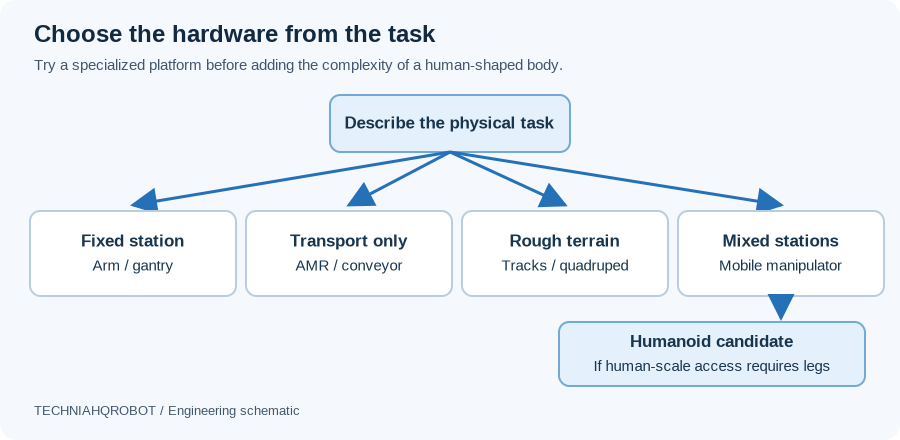
| Situation | First alternative to test | Why consider a humanoid? |
|---|---|---|
| One fixed, repetitive pick-and-place station | Industrial arm or gantry | Only if the same machine must reach multiple human-designed stations. |
| Moving loads on a flat warehouse floor | AMR, conveyor or powered cart | When load pickup and placement need manipulation at different heights. |
| Flat work area with several manipulation stations | Wheeled mobile manipulator | When a wheeled base cannot access a required position safely. |
| Stairs or human-size work areas | Specialized mobile robot or legged platform | When access plus dexterous manipulation are both necessary. |
| Visual checks of passing objects | Fixed camera and sorting mechanism | When several changing viewpoints require handling the object. |
| Rough ground without human-scale handling | Tracked vehicle, quadruped or drone | Only if the job also requires manipulation that alternatives cannot perform. |
Measure aisle width, doorway clearance, reachable surfaces, required object mass and geometry, floor conditions and the consequence of a failed action. Then estimate the time and money to integrate each candidate. The humanoid body is justified only when its flexibility solves a constraint that the simpler system cannot solve at acceptable cost.
Calculate whether a humanoid could pay for itself
Prices and demonstration videos cannot establish return on investment. Measure accepted work across scheduled hours including downtime, charging and resets. The following worked example uses made-up assumptions for a tote transfer comparison. It is a planning exercise, not actual Digit or Figure performance or a vendor quotation.
| Input or result | Humanoid A | Fixed cell B |
|---|---|---|
| Scheduled time | 8 hours | 8 hours |
| Available fraction (ready to work) | 75% | 90% |
| Active cycle time | 40 seconds | 30 seconds |
| First-pass accepted fraction | 95% | 98% |
| All-in scheduled hourly cost | $30 | $40 |
| Expected accepted transfers per shift | 513 | 846.72 (about 847) |
| Total cost per shift | $240 | $320 |
| Cost per accepted transfer | $0.47 | $0.38 |
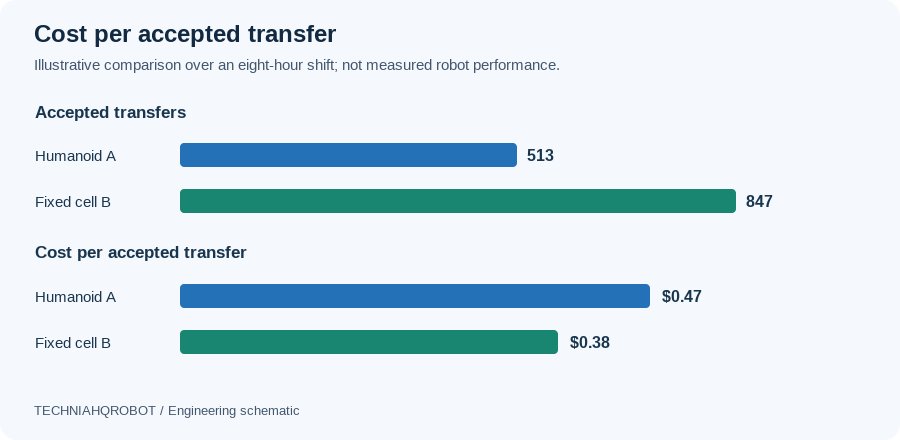
The calculation is: active cycles = scheduled hours × 3,600 × availability ÷ active cycle seconds. Accepted transfers = active cycles × first-pass accepted fraction. Cost per accepted transfer = total shift cost ÷ accepted transfers. For A, 8 × 3,600 × 0.75 ÷ 40 × 0.95 = 513.
The fixed cell costs more each hour in this example but delivers more accepted transfers. If it cannot access multiple workstations without rebuilding them, include the extra equipment and integration expense. Recalculate with actual demand, maintenance, supervision, safety integration, training, changeovers and exception handling. Do not count a robot as saving a full human shift unless the human time is actually freed.
Try your own numbers
Change the assumptions to compare two automation options. The starting values match the example above.
A practical pilot checklist before buying or deploying a humanoid
Define one bounded task with a repeatable start and end state. A buyer, researcher or student can use this protocol to compare vendors and obtain evidence beyond a demonstration.
- Document the item dimensions, mass, permitted grip, pickup and placement positions and the conditions under which the robot must stop.
- Measure the current process: accepted units per shift, error types, labor time, infrastructure and handling costs.
- Select a sample of normal objects and approved variations. Include a safe exception such as a missing item or unavailable destination.
- Agree on a supervised trial and acceptance criteria appropriate to the task. Do not use the suggested workflow as a substitute for site safety procedures.
- Log the robot model, software version, operating mode, scheduled and active time, attempted actions, accepted results, operator interventions, failure cause and recovery duration.
- Compare results with the current process or simpler automation using the same acceptance definition and time window.
| Attempt | Condition | Outcome | Human help | Recovery |
|---|---|---|---|---|
| 1 | Normal tote | Accepted | No | None |
| 2 | Tote outside approved pickup zone | Safe stop | Yes | Operator repositions tote |
| 3 | Conveyor unavailable | Waiting; not accepted | No | Resume after availability signal |
| 4 | Normal tote | Accepted | No | None |
A pilot review should distinguish completely autonomous success from operator-assisted success, and a service agreement from observed operation. Those distinctions matter when evaluating the company records below.
Five kinds of use, five kinds of evidence
A humanoid robot in 2026 is used in one of five ways: paid work for a named customer, a pilot at a customer site, a use that exists only as an announcement or target, research and teaching, and entertainment including competitions and rental. Each tier has its own kind of evidence. A customer press release, a company filing, a journalist's visit and a company livestream do not carry the same weight, and this guide labels every item with its tier and its source. [3] [2]
| Tier | What it requires | Examples below |
|---|---|---|
| Deployment | A named customer, a signed agreement and work performed | Digit at GXO |
| Pilot | A customer site, a stated trial scope, no commitment to continue | Figure 02 at BMW; Apollo at Mercedes-Benz and Jabil; Walker S1 at Zeekr |
| Announcement or target | A plan, a capacity figure or an order value without delivered work | Atlas at Hyundai; Catalyst Brands agreement; Schaeffler targets |
| Research and teaching | Published papers and purchasable research platforms | Unitree G1 and H1 in university labs |
| Entertainment and rental | Competitions, shows and day-rate hire | World Humanoid Robot Games; Chinese rental market |
Paid deployments with named customers
Agility Robotics' Digit at GXO Logistics is the clearest case. GXO's own release of 27 June 2024 describes a multi-year robots-as-a-service agreement at a Spanx facility, where Digit moves totes from collaborative robots onto conveyors, building on a pilot the year before. Agility later said Digit had moved more than 100,000 totes at the Flowery Branch, Georgia site, and its September 2026 announcement, filed with the SEC, states about 98 percent on-task accuracy at GXO and more than 65,000 cumulative hours across the fleet. The robot count has never been disclosed. [3] [Source ↗] [Source ↗]
The June 2026 merger filing adds the commercial picture: deployment commitments across nine customer facilities, over 300 million dollars of multi-year contracted Digit v5 orders subject to milestones, and Schaeffler, GXO, Toyota Motor Manufacturing Canada and Mercado Libre as named customers. The same process disclosed 1.8 million dollars of net sales in 2025 against a 140 million dollar operating loss, which is the scale of paid humanoid work at the company with the longest deployment record. [Source ↗] [Source ↗]
Figure's agreement with Catalyst Brands of 26 May 2026 is described by Figure as a commercial agreement to deploy humanoids in the retailer's distribution network, starting at its Reno, Nevada centre. No robot count, start date or payment terms are given. In China, UBTech reported 921 full-size humanoids sold in the first half of 2026 and 590 million yuan of humanoid revenue in its interim results, without naming the buyers; its November 2025 release lists BYD, Dongfeng Liuzhou, Geely, FAW-Volkswagen Qingdao, Audi FAW, BAIC New Energy, Foxconn and SF Express as customers or partners without per-customer values. [Source ↗] [Source ↗] [Source ↗]
Pilots in car plants and warehouses
BMW's release of 25 June 2026 closes the best-documented pilot. Figure 02 worked in the Spartanburg body shop inserting sheet-metal parts for welding and, in BMW's words, supported production of more than 30,000 X3 vehicles over ten months; the pilot is described as completed. Figure 03 is to start on logistics sequencing, picking unsorted parts from containers into trolleys, with no count or payment stated. [1]
Mercedes-Benz and Apptronik signed a commercial agreement in March 2024 to explore delivering assembly kits, inspecting components and moving totes. A Reuters report of March 2025 puts a handful of Apollo robots at Berlin-Marienfelde and Kecskemét, learning through teleoperation, with a Mercedes investment described as a low double-digit million euro sum. Jabil runs Apollos on intralogistics tasks in one of its own factories while building the robot as Apptronik's manufacturing partner. UBTech's Walker S1 sorted materials and installed components at Zeekr's Ningbo plant in 2025, described as factory interns. Mercado Libre is testing Digit in San Antonio. [Source ↗] [Source ↗] [Source ↗] [Source ↗] [Source ↗]
The IFR's first count of the market, reported in September 2026, puts the pattern in numbers: about 7,000 humanoids sold worldwide in 2025, many bought to generate training data rather than to do work, and carmaker pilots that run single- or double-digit fleets. [2]
Announcements and targets
Tesla's Q4 2025 update says preparations are under way for the first Optimus production line, with the start of production planned before the end of 2026 and an eventual planned capacity of one million robots per year. The Q2 2026 update says the Fremont Model S and X lines were decommissioned for first-generation Optimus lines and that initial builds will be used in the Optimus Academy for training-data collection. No Tesla document states a number of robots at work in a factory. [Source ↗] [Source ↗]
Hyundai Motor Group said at CES 2026 that Atlas will be introduced at Metaplant America in Georgia from 2028, starting with parts sequencing and expanding to assembly by 2030, alongside a 30,000-unit annual production target. Schaeffler has three separate plans on record: Agility humanoids across its 100 plants by 2030, a mid-four-digit number of Neura humanoids by 2035, and a binding phased deployment of Humanoid's wheeled units at Herzogenaurach and Schweinfurt from December 2026 to June 2027. AgiBot reported its 15,000th robot produced in June 2026, a production count rather than a shipment figure. [Source ↗] [Source ↗] [Source ↗] [Source ↗] [Source ↗]
For the home, 1X opened NEO orders in October 2025 at 20,000 dollars or 499 dollars per month with first consumer shipments planned for 2026, and opened a Hayward factory in April 2026 with units so far going to development and internal home testing. 1X says owners can schedule a 1X Expert to guide the robot through unknown tasks; a Wall Street Journal visit, reported by Road to VR, saw no task performed autonomously. Figure's May 2026 livestream of 22,000 packages over 17 hours was run by the company at an unnamed site and is not an audit. [Source ↗] [Source ↗] [Source ↗] [Source ↗]
Research and teaching
The largest documented use by unit count may be the laboratory. Unitree lists the G1 from 13,500 US dollars and the H1 at 90,000 dollars with a note to ask for the real price, and both appear across 2025 and 2026 papers, from motion tracking without fine-tuning to the posture and reflex studies covered on this site. These robots are bought to run experiments and collect data, which is consistent with the IFR's remark that many 2025 sales were made to generate data rather than to perform work. [Source ↗] [Source ↗] [Source ↗] [2]
How OCLO coordinates a humanoid's body: a G1 research example
Entertainment, competition and rental
The World Humanoid Robot Games in Beijing are the largest documented gathering of working humanoids. The first edition in August 2025 drew 280 teams, more than 500 robots, 16 countries and 26 events. The organizers' figures for the second edition in August 2026 are 666 teams, 2,056 robots and 51 events, with a 100 m record of 9.39 s. [Source ↗] [Source ↗]
Rental is the other paid use that can be priced. China Daily reported in May 2026 that a Unitree G1 rents for 2,500 to 3,500 yuan a day, that humanoid day rates fell from about 30,000 yuan in early 2025 to about 3,000, and that 38,200 robot-rental businesses were registered in 2025 according to Qichacha. The rental article on this site reads those rates against the service delivered. [Source ↗]
What no one has published: independent productivity data
No independent measurement of a humanoid's throughput or uptime at a customer site was found. The site metrics that exist, 100,000 totes, 98 percent on-task accuracy, 65,000 fleet hours, 30,000 cars, 22,000 packages, come from companies involved in the projects, including the customer BMW, rather than independent audits. Agility's SEC filings disclose contracted orders and revenue but no uptime or throughput. Gartner's January 2026 forecast that fewer than 20 companies will take humanoids into production for manufacturing and supply chain by 2028 is qualitative and gives no figures either. [Source ↗] [1] [Source ↗] [Source ↗]
For a buyer, ask for three missing indicators: robot count at one site, scheduled and productive hours, and interventions per hour. A commercial deployment describes a contract and operating activity; disclosure of these indicators is necessary for a productivity assessment, not for determining whether the contract exists. [Source ↗] [2]
Sources and verification
- BMW Group press release on Figure humanoids at Plant SpartanburgBMW Group · Read 19 October 2026
25 June 2026. Figure 02 pilot completed in the body shop, supporting production of more than 30,000 X3 vehicles over ten months; Figure 03 to start on logistics sequencing.
- Humanoid robot sales reached about 7,000 in 2025TechRepublic, citing Reuters and the IFR · Read 19 October 2026
24 September 2026. IFR's first humanoid tally; many units bought to generate training data; carmaker pilots run single- or double-digit fleets.
- GXO signs industry-first multi-year agreement with Agility RoboticsGXO Logistics · Read 19 October 2026
27 June 2024. Robots-as-a-service agreement at a Spanx facility; tote moving from cobots to conveyors; no robot count.
Evidence limits
- No independent measurement of humanoid throughput or uptime at a customer site was found in the original October survey. The published metrics come from parties involved in the project, including BMW as the customer.
- Agility has never disclosed how many Digits are in the field. Figure and Catalyst Brands disclose no robot count. UBTech's 921 half-year units are not broken down by customer.
- BMW says ten months; Figure's CEO says eleven. The BMW figure is used.
- Tesla's Q2 2026 update is quoted through a transcription site; the 8-K cover confirms the exhibit exists. No Tesla page states a number of Optimus units at work.
- No confirmed delivery of a NEO to a paying customer was found by 19 October 2026.
Article history
Added a sorted guide after the question appeared repeatedly in reader searches. Company releases, customer statements, SEC filings and dated press reports checked on 19 October 2026.
Added an application map, original workflow diagrams, platform comparison, illustrative cost model and pilot measurement checklist; checked three additional manufacturer/customer sources.